The Elk Canyon & Western Railroad
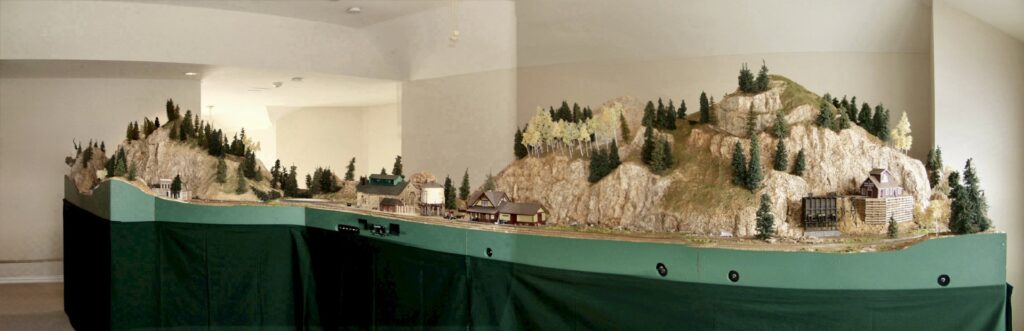
The ECW&RR was a portable switching style layout using a track plan inspired by D&RGW trackage at Ouray, Colorado. It was an “S” scale narrow gauge or Sn3 layout. The layout was powered with a wireless digital command control system known as EASY DCC sold by CVP Products.
The layout is a “Narrow Gauge” layout. Narrow gauge means the distance between the rails is less than the 4’ 8 ½” standard gauge measurement. Here, narrow gauge is 3’ between the rails. Prototype railroads, such as the Denver & Rio Grande Western, Rio Grande Southern, Colorado & Southern and West Side Lumber Company, built their railroads using narrow gauge track. This allowed these railroads to be built faster using lighter weight equipment with tighter curves. Narrow Gauge railroads were in a hurry to get into the mountains to haul out valuable gold and silver ore. They also brought timber down from the mountains to build towns in the expanding western United States between 1875 and the 1950s.
‘S’ scale is 3/16” to the foot or a ratio of 1:64; thus, the real object is 64 times larger than the ‘S’ scale model. ‘S’ scale is larger than ‘HO’ scale in which the real object is 87 times larger than the model. ‘S’ scale is smaller than ‘O’ scale in which the real object is 48 times larger than the model. Sn3 is frequently described as the “perfect” scale. Details, such as steam valve gear, handrails and grab irons, actually become visible but are not oversized as often happens in smaller scales. Besides the bonus of being 36% larger than HO scale equipment, an Sn3 layout can be constructed in virtually the same space as an ‘HO’ standard gauge layout.
The ECWRR is powered using a DCC system. Each engine contains a decoder, which receives a signal transmitted by the command station. The signal is carried through the rails to the engine. The beauty of a DCC operated layout is that you are no longer limited to running a train in one direction based on the polarity of the electrical voltage. Each engine is operated independent of track polarity. Using DCC means you can have two engines move toward one another if you want to risk an old-fashioned cornfield meet. Engines on the ECWRR house a Tsunami decoder produced by Soundtraxx. Tsunami decoders provide a variety of steam and diesel sounds. In today’s world of model railroading, you can now operate with realistic sound and movement just like the prototype.
The ECWRR uses engines and rolling stock imported or manufactured by PBL. Each engine or car is an exact model of the real thing.
The First Layout
In the summer of 1998, Gary Rush from Lewisville, TX put out word via the Internet of his intention to gather a group of guys to build a portable layout in Sn3. Gary connected with Keith Stamper, a Canadian modeler who had recently relocated to Denton with his job. Shortly thereafter, Marc LaChey of Richardson contacted Gary and Keith. The nucleus of the NTNG was formed.
It wasn’t too long before other members joined the group. Those were Randy Smith, Paul Cleveland, Tom Petrick and Clark Womack. This group built the first Sn3 layout. That layout was displayed at the Plano Train Show from 2002 to 2005.
With Keith Stamper relocating back to Canada around 2005, we lost our home for the first layout. So, we sold the layout and started a new project in On30. The On30 layout reached the stage of having an operating loop of track, but no scenery. The groups' enthusiasm for the On30 project waned as did the size of our group, so the few remaining members salvaged the On30 layout and began to look for new layout ideas.
After considering how to transport the new layout, Tom Petrick and Marc LaChey realized that we could only handle a layout that would fit into the back of Marc’s Chevrolet Suburban. Marc & Tom started reading layout books by Ian Rice and articles written by Treavor Marshall and Pierre Oliver. The result was the development of a switching layout in Sn3 which we named the Elk Canyon and Western. Construction on the ECW started in 2009 in the garage of a friend of the group, Kenny Collins. Go to the tab for the Elk Canyon & Western under Layouts for more information on the Elk Canyon & Western Layout.
One of the strengths of the NTNG group is that unlike other modular groups in which the builder owns an individual module, the ECWRR is a group effort. A fundamental premise of our work is that the member who has the best skill or talent for the job leads or does that job. This allows us to build on our members’ strengths.
Our most recent project is the Rush Creek Lumber Company, a logging themed layout again in Sn3. What makes this layout unique is that we use the rolling storage cabinets as a base for the layout.